

Capacity Planning & Budgeting
See future staffing risk early enough to make better service, cost and budget decisions
Future staffing problems are easier and less expensive to address while there is still time to recruit, train, improve productivity, expand outsourcing or secure the necessary budget.
A capacity plan compares the resource required to meet future demand with the capacity expected to be available after shrinkage, attrition, recruitment timing, productivity, outsourcing and other planning assumptions are applied. It shows where staffing gaps or surpluses may emerge, how large they could become and which options are available.
In customer operations, capacity planning often looks ahead 18 months to two years. This matters because recruitment, training, outsourcing, budget changes and performance improvement all take time. If a gap is identified too late, the remaining options become more limited and more expensive.
Atlantic WFM helps organisations build capacity plans that support decisions on service, cost, recruitment, outsourcing, budgets and operational change.
When capacity planning support can help
- staffing or service problems are being identified too late
- recruitment plans are not clearly connected to demand
- outsourcing decisions are being made without sufficient modelling
- budget assumptions do not reflect operational requirements
- leaders lack a reliable view of future staffing gaps or surpluses
- an existing plan is difficult to explain, update or maintain
- Operations, Finance and senior leaders do not fully trust the capacity position
- planned changes to technology, productivity or the operating model need to be tested
It can also help capable planning teams strengthen assumptions, improve scenario modelling and create clearer outputs for operational and financial decisions.
Make future pressure visible
A useful capacity plan shows whether the operation is likely to be short or over capacity, when the position changes and which assumptions are driving it. It also allows leaders to test the effect of higher demand, increased attrition, recruitment delays, productivity changes or moving more work to an outsourcing partner.
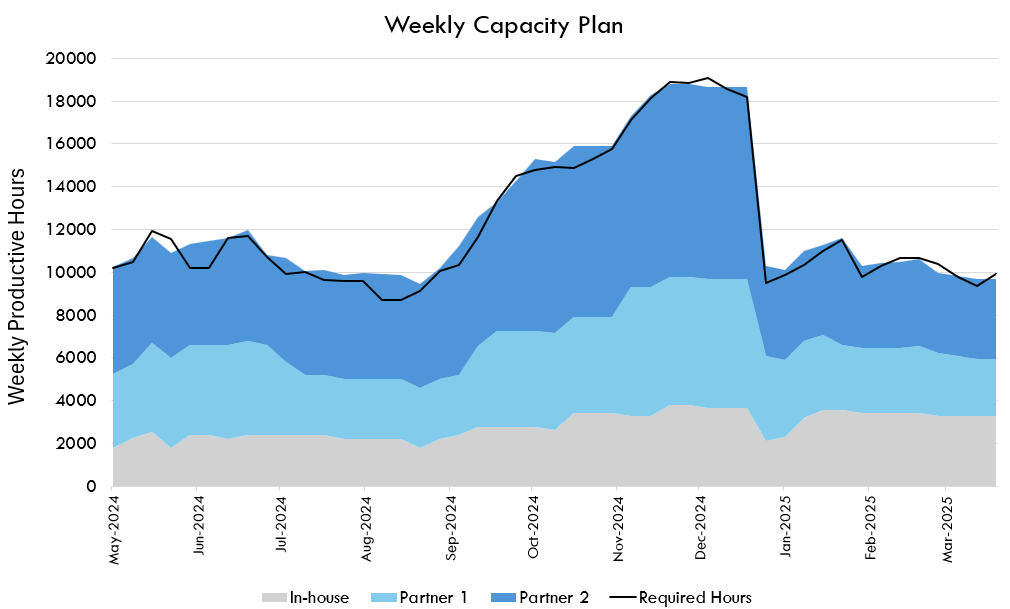
This example compares required productive hours with expected available capacity across in-house and outsourcing partner teams. It shows when gaps or surpluses may emerge, helping leaders decide whether to take action, such as recruit, expand outsourcing, improve productivity or secure additional budget.
What good capacity planning requires
Capacity planning begins with sound inputs. Demand forecasts, productivity, handling times, shrinkage and other performance assumptions need to be realistic and explicit. Weak inputs can produce a misleading capacity position, regardless of how polished the model appears.
Recruitment plans, attrition, training lead times and outsourcing partner capacity determine how available resource will change. Scenario modelling shows how gaps or surpluses may develop under different assumptions and gives leaders time to consider the available responses.
Regular validation keeps the plan connected to operational reality. Forecasts, resource requirements, available capacity and planning assumptions should be compared with actual outcomes and updated when conditions change. This allows the planning process to improve over time.
Outputs should be clear enough to support budgeting, reforecasting and strategic decisions about service, cost, recruitment, outsourcing and operational change. Leaders need to understand the capacity position, the assumptions behind it and the choices requiring action.
What clients receive
New capacity planning models
A decision-ready model comparing required and available capacity, with explicit assumptions for demand, shrinkage, attrition, recruitment, productivity, service goals, outsourcing and budgets.
The work can include scenario views, leadership and Finance outputs, validation checks, documentation and the transfer of knowledge needed to maintain the model internally.
Review and improvement of an existing plan
An independent assessment of the model, assumptions, calculations, scenarios, outputs and planning routines already in place.
The review identifies where credibility, usability or maintainability is being lost and recommends the changes most likely to produce a more reliable basis for operational and financial decisions.
For either type of engagement, we can help establish who owns the assumptions, how often the plan is updated, how it is validated and how its outputs are used in Operations, Finance and leadership forums.
Outcomes and benefits
Better capacity planning gives leaders time to act before staffing risk becomes service failure, avoidable cost or budget pressure. It can help the organisation:
- take earlier action on recruitment, outsourcing and performance improvement
- reduce the risk of overstaffing, understaffing, avoidable overtime and missed service
- create more realistic staffing and budget assumptions
- improve customer experience by protecting service and response times
- protect revenue where capacity, availability or backlogs affect conversion and retention
- improve colleague experience by identifying unsustainable workload pressure earlier
- test the potential effect of technology, productivity and operating-model changes before decisions are finalised
Why Atlantic WFM?
Capacity planning that stands up to operational and financial scrutiny
Atlantic WFM brings direct experience of building capacity plans for contact centres, back-office operations, branch networks, case-management teams, digital operations and outsourced environments.
Philip Stubbs has led planning teams, built capacity models, managed budget discussions, advised on outsourcing decisions and helped operational leaders understand future staffing risk. This combines detailed modelling experience with an understanding of the senior operational and financial decisions the plan needs to support.
Selected capacity planning assignments
- Major outsourcing provider - designed a standardised capacity planning model using annualised hours to support consistent planning across multiple client accounts
- Digital retailer - developed a capacity plan for email and social media operations to support staffing and service planning
- Building society - developed a capacity plan to support staffing and budgeting decisions
- Bank - built a capacity planning model linking demand forecasts to resource and budget consequences
- Travel business - produced a capacity plan to improve visibility of future staffing requirements
- Insurance branch network - built a capacity plan to support workforce planning across multiple locations
- Financial software provider - developed a capacity plan for a case management operation to support delivery planning
Client perspective
Claire Hill, Customer Operations Director
Frequently asked questions
What is the difference between forecasting and capacity planning?
Forecasting estimates future demand. Capacity planning translates that demand into resource requirements and compares them with expected available capacity, supporting decisions on staffing, budgets and delivery.
Is capacity planning only useful for annual budgeting?
No. It also supports reforecasting, recruitment planning, outsourcing decisions, scenario modelling and ongoing operational decisions throughout the year.
What assumptions can the capacity plan include?
The plan can include demand, productivity, handling times, shrinkage, attrition, recruitment, training lead times, outsourcing, service goals and budget constraints. The assumptions included will reflect the operation and the decisions the plan needs to support.
Can the plan test operational changes or improvement initiatives?
Yes. It can test the potential effects of new technology, productivity changes, outsourcing, revised service goals or changes to the operating model before decisions are finalised.
How do we know the plan is credible?
Credibility comes from explicit assumptions and regular validation. The model and its inputs should be compared with actual operational outcomes so future decisions remain connected to current performance.
Request a conversation about Capacity Planning & Budgeting
If you need earlier visibility of staffing risk, a stronger link between resource and budget or a more reliable basis for capacity decisions, we can discuss the planning issues you are seeing and what would help.