
Exploring your customer operation through simulation gives a great understanding of its dynamics. Calls, emails and other tasks are generated in the model just as they occur in real life. The simulation processes these tasks and produces results that can be compared against actual outcomes, validating accuracy. Then new scenarios can be fed into the model, to observe what happens under different conditions, without actually making the changes in real life.
When used to set future resource requirements, a simulation model should be an accurate operational replica, delivering the right balance of customer experience at the precise cost. If the behaviour of customers is modelled correctly, it’s likely to give more accurate results than queueing theory models. Simulation protects revenue, improves efficiency, and ensures staffing is aligned to demand, boosting both employee and customer satisfaction.
A simulation model can serve as a digital twin of your customer operation. It lets you safely test “what-if” scenarios, such as multiskilling, routing changes, technology implementations, process tweaks or volume fluctuations, without risk. You can see the real impact on service levels, resource requirements, and operational efficiency before making changes in the real world. This virtual environment enables you to trial operational decisions, anticipate their effects, and continuously optimise performance, making it a powerful tool for both strategic and tactical planning.
I built my first contact centre simulation in the early 1990s. It demonstrated significant cost savings and service benefits that were possible through the merging of individual bureaux within British Gas. I have subsequently developed other simulations for contact centres.
In the last two years I’ve spent time building Python tools, including data manipulation, advanced forecasting and queueing theory models. And recently I’ve developed Python-based simulation code for an inbound contact centre.
Specific simulation platforms exists, such as Witness and Simul8, and they have their advantages. Yet Python lowers the entry cost to experiment with simulation. Python also allows the code of an operational simulation to combine seamlessly with data modelling and forecasting pipelines. And with efficient coding, it runs very quickly.
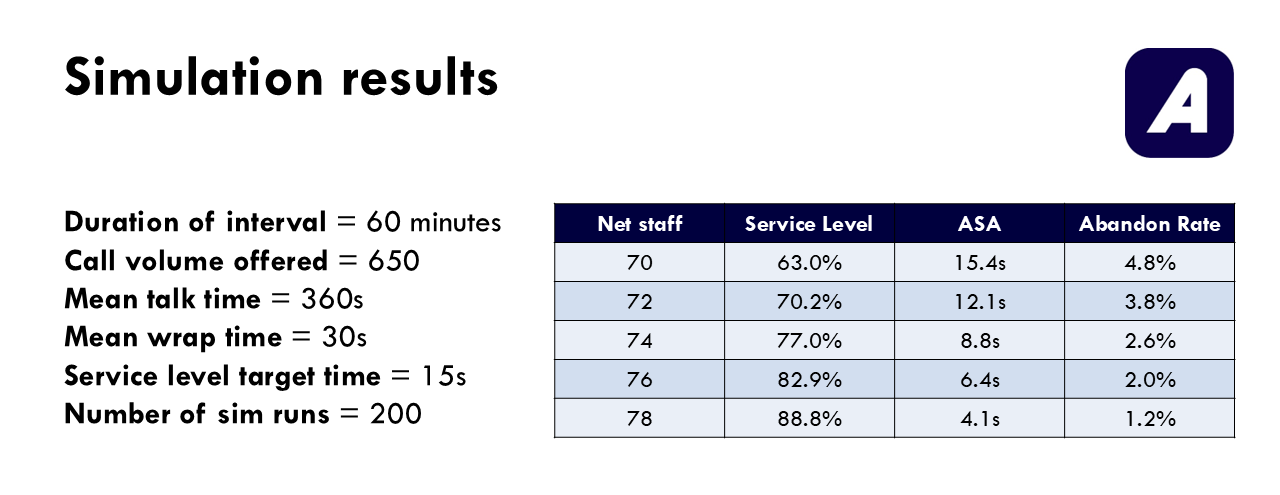
My next step is to launch a single-interval Python simulation as a web application early next year. You’ll be able to enter details for a sample hour from your contact centre, run the simulation, view results, and then iterate with different setup conditions to explore alternative scenarios.
Please contact us if you are interested in exploring the us of simulation within Customer Operations